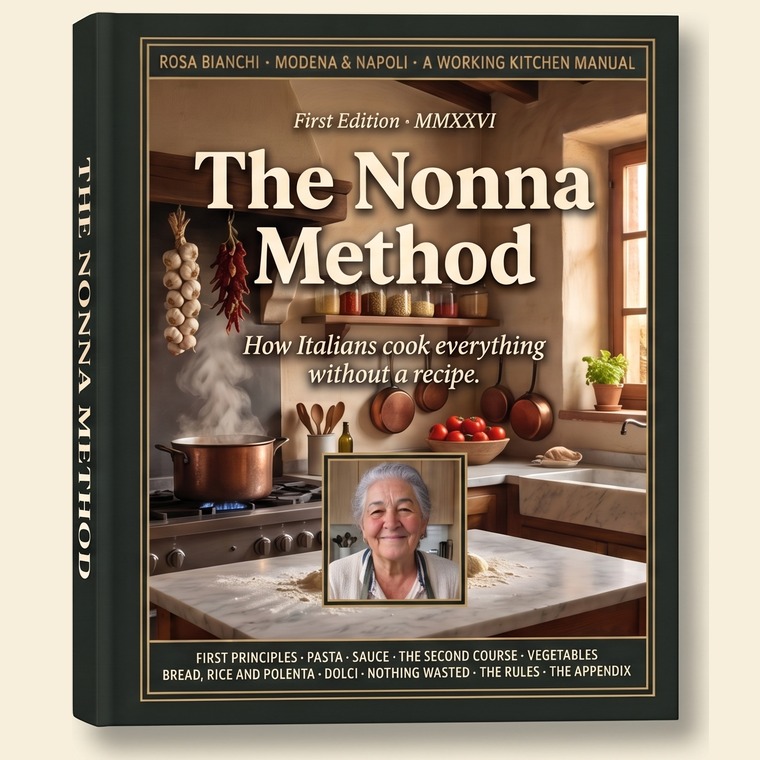
Sixty-one years at the stove, half in the north and half in Napoli, written down as method rather than recipe. The twelve or fifteen governing ideas a nonna learns so early she forgets they are ideas at all — and from which every dish is assembled on the spot, out of whatever is in the house that day.
Instant download · Yours forever
“Cook one thing. Cook it four times. The fourth time you will not need the page.”
Rosa BianchiWhen I was nine years old I stood at my grandmother's elbow in a kitchen in the province of Modena and watched her make a ragù. She did not measure. She did not own a scale. She did not have a cookbook in the house, and if she had, she could not have read much of it. And what she made was better than what most restaurants in Italy serve today.
This was not magic and it was not talent. She had learned twelve or fifteen governing ideas, so early and so completely that she had forgotten they were ideas at all. From those, every dish she ever made was assembled on the spot, out of what was in the house.
That is what The Nonna Method is: those governing ideas, written down, in order, with the reasoning underneath them, so that a person who did not stand at anyone's elbow can learn them anyway. Half of my cooking life has been in the north, where the pasta is made with eggs and the fat is butter. Half of it in Napoli, where my husband was born, where the pasta is dry, the fat is oil, and the tomato is a religion.
Where a method has a cost, I tell you. Where it does not work, I tell you that too. There is a great deal of nonsense written about Italian food, most of it by people selling something, and I have tried very hard to write a book with none of it in.
The Nonna Method · First Edition · MMXXVI
147 pages · 9 parts · 3 appendices
A recipe teaches you one dish. A method teaches you the reason underneath every dish — which is why a nonna can open an empty-looking fridge and put dinner on the table anyway.
Every chapter opens with the trouble, so you know what is being fixed. It teaches the principle, then the technique, in the order a person would learn them standing next to me. Each one ends with The Rule — the single sentence to carry out of that chapter.
Instant download · Yours forever
“Chapter 4 alone. I have been salting pasta water with a pinch for thirty years and wondering why mine never tasted like my mother's. It is not the sauce. It never was the sauce.”
“I made the Sunday ragù twice and the third time I did not open the book. That has never happened to me with a cookbook. My husband asked what I had changed. I had changed nothing — I had just understood it.”
“The Rules at the end of each chapter are the whole thing. I copied all thirty-four onto index cards and taped them inside the cupboard door. I cook out of an empty fridge now and nobody complains.”
I have cooked for sixty-one years. I learned in the province of Modena, at the elbow of a woman who could not read a cookbook and did not need one. I married a man from Napoli and spent the second half of my life in a kitchen where the pasta is dry, the fat is oil, and the tomato is a religion.
I have burned things. I have thrown away a whole pot of sauce more than once. I have made every mistake in this book personally, which is how I know they are the ones that matter.
I did not write this to be a chef. I wrote it for the ones who cook every day for people who never ask how it was done — and for the ones who never got to stand at anybody's elbow, and want to learn it anyway.
Do not try to learn it all in a week. Cook one thing. Cook it four times. The fourth time you will not need the page.
How Italians Cook Everything Without a Recipe · First Edition
Launch promo · ends at midnight
Get The Nonna Method — $47 $27Instant download · Yours forever
It is how I cook, and how the women I learned from cooked, in Modena and in Napoli, over sixty-one years. I am not a purist and I distrust them. There are Italian dishes with long ingredient lists and they are magnificent — a proper ragù bolognese, a vitello tonnato, a timballo, most of the Christmas table. Feast food is complicated on purpose.
What this book teaches is the everyday cooking underneath the feast: the governing ideas that let a person put good food on a table on a Tuesday, out of what is in the house. Where a method has a cost, I say so. Where it does not work, I say that too.
The videos are one thing at a time, in whatever order I filmed them. The book is the method in order, start to finish, with the reasoning written underneath each step — the part that never fits in a video.
It is also the part you can hold open on the counter while the pan is going, and the thirty-four Rules in one place instead of scattered across a hundred videos. Keep watching the videos. The book is for when you want the whole thing.
No. It is written in the order a person would learn standing next to me. Start with Part One and read the five chapters there in order — they are short, and everything after them leans on them. Chapter 4, on salt, is the one people skip and the one they most need.
If you already cook well, start anywhere. The Contents groups the chapters so you can go straight to the thing you want to fix tonight.
A big pot, a pan, a wooden spoon and a knife. Chapter 11 teaches filled pasta with no special equipment at all, and Chapter 10 teaches fresh dough by hand. The pantry appendix lists what is worth keeping in the house — it is a short list and an ordinary supermarket carries nearly all of it.
Because it is a file and not a printed book, and because I would rather it be in a thousand kitchens than on ten shelves. $47 is what it will sell for once the launch promo ends. Until then it is $27, which is less than one bad restaurant plate of pasta.
Two PDFs, delivered the moment you order — no waiting for post. You get the plain manual and The Illustrated Edition, which is the same complete book set with forty-nine photographs through the chapters. Some people want the pictures; some want the words and nothing else. You get both and can decide for yourself.
Either one reads on a phone, a tablet or a computer, and prints cleanly if you would rather have paper in the kitchen drawer where the flour can get at it. They are yours to keep.

Thirty-four chapters, thirty-four Rules, sixty-one years of cooking — and both editions, plain and illustrated — for $27 until the launch promo ends at midnight. After that it is $47.
Get The Nonna Method — $47 $27 or see what's inside →